


Finishing the Year Strong
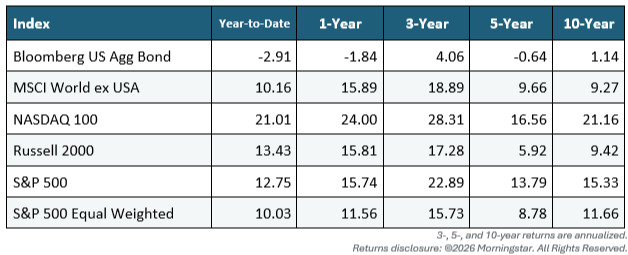
Through the first nine months of 2026, equity markets continued to produce solid gains across most major asset classes. The NASDAQ 100 led the way with a year-to-date return of 21.01%, while the S&P 500 returned 12.75% and the Russell 2000 gained 13.43%. International markets also posted strong results, with the MSCI ex USA Index advancing 10.16% year-to-date. Fixed income was more challenging, as the Bloomberg U.S. Aggregate Bond Index declined 2.91% through September 30. While returns varied across asset classes, the results reinforce the value of maintaining a diversified portfolio across domestic equities, international equities, and fixed income.
Investment Returns (as of 9/30/2026)
Here are three market trends worth highlighting:
· Inflation continues to remain above the Federal Reserve’s target due to a growing economy, more debt issuance, and supply shocks from geopolitical events, notably oil and natural gas disruptions from the Iran conflict.
· The fixed income market demands higher interest rates. The benchmark 10-year U.S. Treasury yield reached 5.3% in October, its highest level since 2007, reflecting investors' expectations for higher interest rates amid persistent inflation and solid economic growth. So far in 2026, corporate earnings overall have remained strong despite the rise in interest rates.
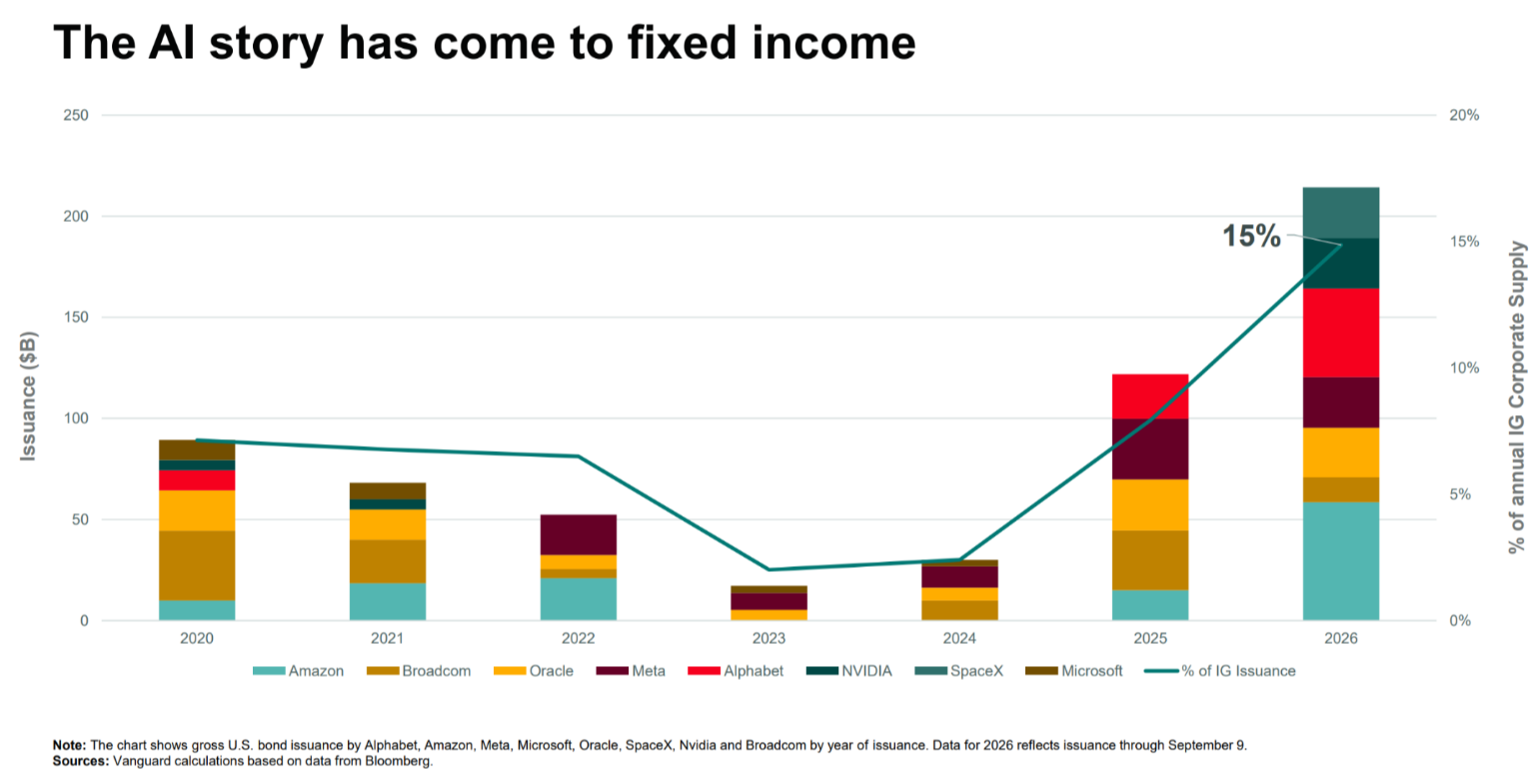
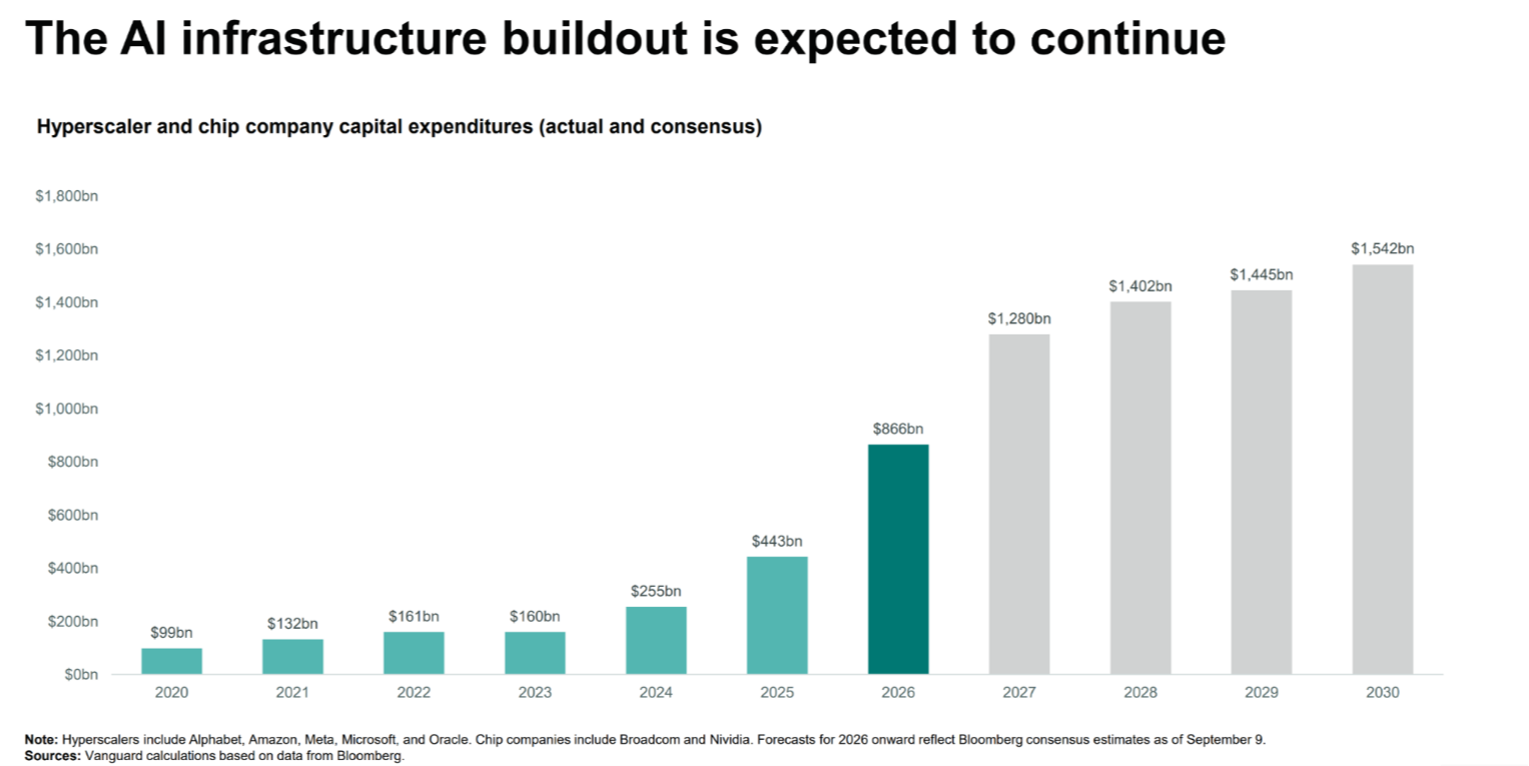
· Bond market supply has increased from a surge in issuance from technology companies, who have increasingly been using debt to finance their Artificial Intelligence (AI) projects. The first chart shows this massive issuance in context of the corporate debt market, while the second illustrates the past and projected dollar amount of this AI buildout.
Here are financial planning topics we are looking at as we work to finish the year strong:
1. Take Required Minimum Distributions (RMDs)
If you are subject to RMDs, ensure your full distribution is taken before December 31. Missing an RMD can result in IRS penalties, and waiting until the last few weeks of the year can create avoidable processing delays.
We will be reaching out to clients with remaining RMDs over the next few weeks.
2. Evaluate Roth Conversion Opportunities
December 31 is the deadline to complete a Roth conversion for the current tax year. A carefully planned conversion may help take advantage of available tax brackets, reduce future RMDs, and increase tax-free assets for retirement and heirs.
3. Review Taxable Accounts for Capital Gains and Tax-Loss Harvesting
Year-end is an excellent time to review taxable investment accounts. Harvesting losses may help offset realized gains and reduce current tax liability, while some clients may benefit from intentionally realizing gains at favorable tax rates.
4. Maximize Retirement Plan Contributions
Review retirement savings progress before year-end.
· Employee 401(k) and SIMPLE IRA salary deferrals generally must be made through payroll by December 31.
· SEP IRA and many employer retirement plan contributions may be made later, generally through the employer's tax filing deadline (including extensions).
· Traditional and Roth IRA contributions for the tax year generally may be made until the following April tax filing deadline.
5. Review Charitable Giving Strategies
For charitably inclined individuals and families, year-end is often the most effective time to implement giving strategies. Consider:
· Qualified Charitable Distributions (QCDs) from IRAs
· Gifts of appreciated securities
· Donor-Advised Fund (DAF) contributions
· Bunching multiple years of charitable gifts into a single tax year

Important Disclosures
Compton Wealth Advisory Group, LLC (“Compton Wealth”) is an SEC registered investment adviser in Virginia Beach, VA and is not affiliated with your bank or brokerage custodian. Registration of an investment advisor does not imply any level of skill or training. The information presented is limited to general information pertaining to Compton Wealth’s services, views, outlooks, and opinions and is for information purposes only. There is no guarantee that the views and opinions expressed in any Compton Wealth content will come to pass. The information presented is subject to change without notice and should not be considered an offer to sell or a solicitation of an offer to buy any security.
Certain information presented may contain a discussion of material economic conditions and/or events that may affect future results. All information is deemed reliable as of the date presented but is not guaranteed and is subject to change.
Certain information is based on or derived from independent third-party sources that, in certain cases, may or may not have been updated through the date of this information. While such information is believed to be reliable for the purposes used herein, Compton Wealth has not independently verified the assumptions on which such information is based nor assumes any responsibility for the accuracy or completeness of such information. Such information is subject to change without notice to you.
References to indices or other financial benchmarks are provided for illustration purposes only. Indices are unmanaged, statistical composites, and an individual cannot directly invest in an index. Index returns portrayed do not reflect the deduction of underlying investment expenses and third-party fees to purchase the securities they represent. Data from the indices (i.e., the S&P 500) are supplied by third-party suppliers. Compton Wealth does not attest to the accuracy or reliability of these numbers, nor the methods of calculation from which they are derived. The indices’ performance data reported represents past performance and does not guarantee future results. Your current account performance may be lower or higher than return data quoted within.
Past performance does not guarantee future results. Certain information set forth herein may contain “forward-looking information”. These statements are not guarantees of future performance, and undue reliance should not be placed on them. Different types of investment involve varying degrees of risk. Therefore, there can be no assurance that the future performance of any specific investment or investment strategy (including the investments and/or investment strategies recommended and/or undertaken by Compton Wealth, or any non-investment related content), will be profitable, equal any corresponding indicated historical performance level(s), be suitable for your portfolio or individual situation, or prove successful. Compton Wealth is neither a law firm, nor a certified public accounting firm, and no portion of its services should be construed as legal or accounting advice. Moreover, you should not assume that any discussion or information contained in this presentation serves as the receipt of, or as a substitute for, personalized investment advice from Compton Wealth. Please remember that it remains your responsibility to advise Compton Wealth, in writing, if there are any changes in your personal/financial situation or investment objectives for the purpose of reviewing/evaluating/revising our previous recommendations and/or services, or if you would like to impose, add, or to modify any reasonable restrictions to our investment advisory services. A copy of our current written disclosure Brochure discussing our advisory services and fees is available upon request at www.comptonwealth.com/disclosures. The scope of the services to be provided depends upon the needs of the client and the terms of the engagement.
Historical performance results for investment indices, benchmarks, and/or categories have been provided for general informational/comparison purposes only and generally do not reflect the deduction of transaction and/or custodial charges, the deduction of an investment management fee, nor the impact of taxes, the incurrence of which would have the effect of decreasing historical performance results. It should not be assumed that your Compton Wealth account holdings correspond directly to any comparative indices or categories. Please Also Note: (1) performance results do not reflect the impact of taxes; (2) comparative benchmarks/indices may be more or less volatile than your Compton Wealth accounts; and (3) a description of each comparative benchmark/index is available upon request.
Artificial Intelligence Disclosures
This publication was prepared with the assistance of artificial intelligence tools (AI”) and was reviewed, edited, and approved by Compton Wealth Advisory Group personnel. These tools are subject to our data security and confidentiality policies. The use of AI does not constitute the provision of automated investment advice, and no investment recommendation is generated solely by an AI system. AI-generated content may be based on third-party information that has not been independently verified in all cases. Compton Wealth Advisory Group remains solely responsible for the content, opinions, analyses, and conclusions expressed herein.